Stay out of the digital oatmeal
Have you ever had a tension headache? Or a study, thinking headache? That tired feeling in your brain after doing a lot of learning — probably you felt it during your highschool exams and college thesis times, probably you felt it when you were trying to learn something new and really struggling. That’s because… learning things isn’t easy. Your brain has to do a lot of work, running through existing connections and building new ones. Over the course of my career as a software developer I became aware that the more I felt I was struggling, the more I was probably learning. It was only weeks or months after the fact that I could reflect and conclude, “oh, I was having a tough time because I was doing something new — and here’s what I learned”.
Learning thing is hard actually
I once experienced this most dramatically when things ‘clicked’ for me in Object-Oriented Programming. I’d been bashing my head against code for months. My approach was to just copy code from examples and tutorials, assert that it works (through mostly manual tests at the time — we’re talking 2003 – 2005 after all), and mumbling to myself “I don’t know why this works but it does”. I learned that in order to understand something, I first needed to put up with the frustration of not understanding it.
Now, everyone learns in different ways. Some people do great by just absorbing an entire manual and then know everything that was in it. Some people do best when watching videos, or having a teacher/mentor explain it to them. Me, I learn best through imitation, followed by examining what I just copied. “I built something that worked, because I did it like this — but why does that work?” Rather than making sure I get it all perfect and understand it perfectly before I build anything, I learn by doing and then reflecting on what I did. (I daresay I’m not unique in this and in fact most developers learn like this, which is why they’re great developers.)
I remember quite vividly the first time I typed something in Java like Button button = new Button(); At that point, I didn’t know what a class was, or an instance, or an object. I just knew I typed four words and three of those were the same word and I thought that was really funny. And that amusement spiked my curiosity and so I learned what those words meant in that context.
Why am I saying all this? Because obviously, nobody wants to learn anymore.
I think with the advent of AI everything, we’ve kind of forgotten that learning things is inherently taxing, frustrating, difficult, time-consuming, and just like, annoying to do. It burns energy, it gives you a headache, it might even make you feel bad about yourself. Because that’s what learning feels like! You don’t start at A and then magically, frictionlessly, arrive at Z. You gotta walk the steps.
But AI allows us to skip many of those steps. It has the capacity to think so you don’t have to, then give you the bullet-list, bolded-keywords, easily-readable version. But in my previously established pattern of learning, if AI writes the code for me, and I then review it by asking about what it just wrote, maybe I’m still learning, though? Maybe… maybe not.
Because I also distinctly remember typing over the example was much more effective than copy-pasting. In a similar vein, if you really want to commit something to your brain, write it down with your own hand. Physically. On paper.
There’s increasing amounts of research pointing to how increased use of LLMs decreases your brain’s capacity to think critically and learn things on its own. “Dumber” or “stupider” is quite a incendiary label, and I prefer to be a bit more precise about it, but the accumulation of cognitive debt is a real thing. And that’s because of the alphabet-journey I described earlier. If you’re skipping steps, you may get there faster, easier; but you simply won’t have picked up the learning along the way (the ‘debt’ the research points to).
Now think about how much time and effort you’ve spent during about the first 20 years of your life in education. School was hard work. Homework sucked. Studying for exams and taking them was so tough you might still have dreams about it. Writing your thesis, pretty much one of the toughest things you ever did cognitively, at least, up until that point. This is not to overvalue traditional education (there are plenty other ways to learn – on the job, self-taught, and so on). But my point is, none of that was easy. Your brain was working hard.
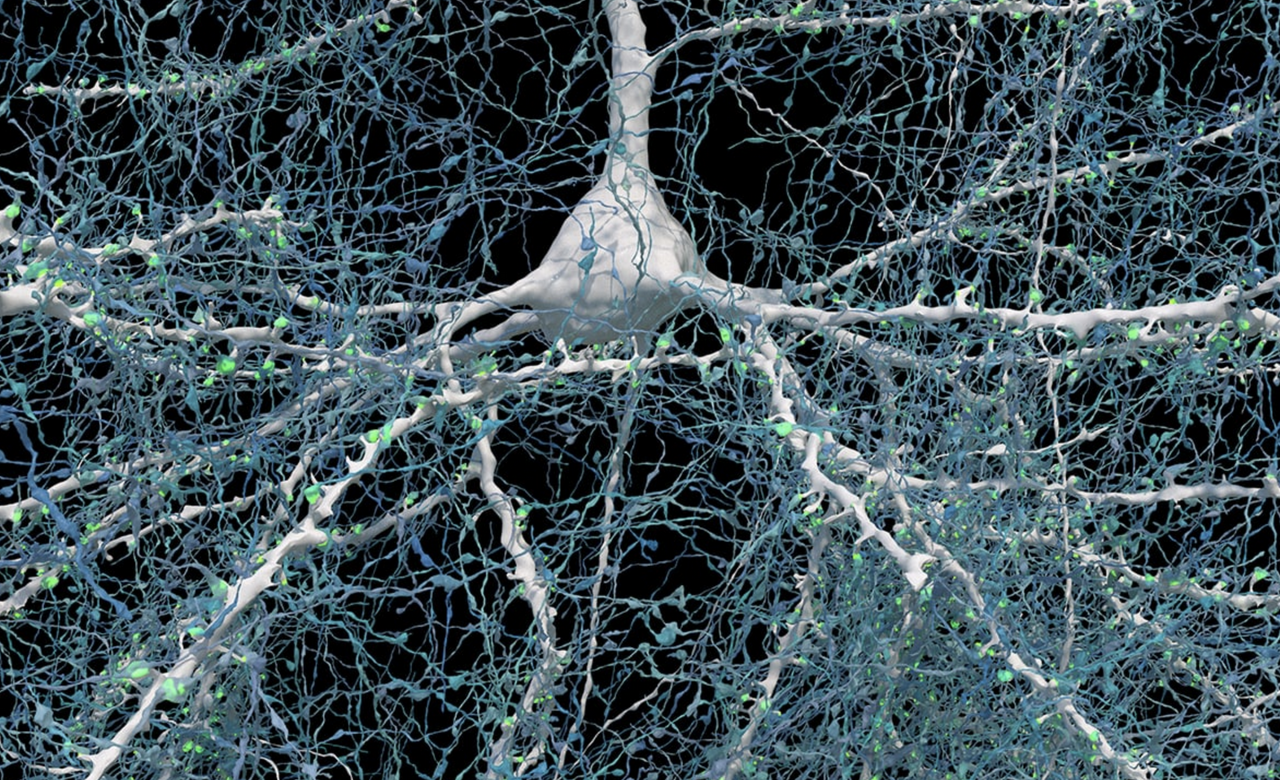
And it’s beautiful. (Source: Unseen details of human brain structure revealed, Google Research & Lichtman Lab, Harvard University. Renderings by D. Berger, Harvard)
I’ve been thinking about this a lot because I had a period last year where I was using LLMs quite intensively. I didn’t feel like I was getting dumber at the time, but that’s the thing, if I was then how would I know? This is the cognitive pitfall – if you are truly losing your cognitive thinking skills then you won’t be able to entirely catch and prevent that from happening. That’s what alarmed me. I was like, “well, I think I’m critically reviewing this thing’s output and still using my own thoughts and judgment but if I wasn’t then how could I be sure?”
The answer maybe is “if you’re at least still questioning that, then you’re good”. At the very least, it’s probably better to doubt yourself, than to just assume whatever the LLM responds with is always correct. If you’re not verifying the output in any way, then you’ve probably already been led astray and you’re not even aware of it…
Anyway, I’ve only been talking about learning so far, but there’s another aspect to this I want to bring up: creation.
Creating things is also not easy, turns out
Just like learning, making things is hard. Truly sitting down and making something out of nothing with your own mind and body is difficult, time-consuming, exhausting, challenging… and you often have to do it a lot, and deliberately, to even have it turn out kinda decent. This was humanity’s shared truth for a long time. Even when things came along that made creation more convenient, it still wasn’t easy. It required real cognitive effort. It’s why professional artists, musicians, writers, will often struggle with a creative ‘block’ where they just can’t synthesize something new; because it’s just that hard sometimes. Especially if they’re faced with their own perfectionism: knowing from talent or expertise what they want the result to be, and then not being able to get there.
The process of creation, and the process of learning, are very similar. When you make something, you are learning, and like me in order to learn anything you often have to go through the process of creation. An obvious example is knitting: you can’t learn how to knit by just watching videos. Your hands have to actually make something. A scarf, a beanie, a blanket. You make mistakes along the way, and you learn, and your knitting improves. You make less mistakes. Your stitches are more uniform. You knit faster.
AI makes it trivial to make something out of nothing. Using only a prompt, you can generate entire essays, songs, graphics, animations. I wonder if it’s because historically we’re used to creation being hard, thus valuable, that we haven’t adjusted to this reality where creation is easy, but we still value it as if it cost a real person blood, sweat and tears — when in fact it just cost you tokens. Because I’m curious and want to understand things I actually played around with these generators, and I found that the quantity is huge and the quality is just… not there. Certainly not the specific quality that I appreciate in any creation, which is the human quality.
I mean, you’re reading a blog post where every word was typed by me (yes, really!) I’m the woman who burst into tears the first time I saw The Sunflowers by Van Gogh and The Water Lilies by Monet. Real, human-made art affects me deeply, and I’m kind of hyper-sensitive to any creation that doesn’t have it.
That’s why over the past months I’ve grown increasingly frustrated and exhausted and annoyed with the AI slop that is just… everywhere. You see, I don’t necessarily mind if things are made with the help of AI (‘help’ doing a lot of heavy lifting in that phrase) Like, I get it, especially in a corporate context. We want more profit faster and what better way to get it than with automation instead of slower more expensive humans? (Although by now it seems humans are the cheaper option.)
What just truly grates me is the bad quality of it. Hands with too many fingers, graphs that are melting, words that are mangled, eyes that just aren’t quite right. Every blog post and LinkedIn post that now just reads the exact same effing way (which is why I am adamant about typing every word here, and if it still ‘sounds like’ LLM-speak that’s because I have unfortunately been influenced by reading and using it too much). Every single time I read “That’s not X, that’s Y” or a bullet-point list with sentences that don’t really say anything. UX designs that all look the same. Video thumbnails that all look the same. Everything is just the same, uninspired, AI-generated sludge. And it sucks, and it’s boring, and it’s just a waste of time to read/watch and a waste of resources to generate.
We can do better. Even if you want to generate things to get a headstart or whatever, you can still use your own judgment, add your own flavor. Hell, if you’re adamant about generating all your social posts at least teach the LLM to write like you so it’s not the same as every post out there nowadays.
Humans are imperfect, so everything we make ourselves is imperfect, which is exactly what makes anything interesting. I love reading something that’s clearly written in someone’s own voice and style. I love listening to music and seeing visual art where I can tell it has the maker’s characteristics there. Not everything has to be smoothed over. More importantly, if everything that’s created is the same, then why even do it? What’s the added value if it’s not expressing who we are and what our own story is? Am I the only one deeply annoyed by how samey everything is getting? (That’s separate from every other criticism leveraged against AI, mind you.)
The real kicker is, as I said, I’m not fully opposed to it. But what I see happening is that the “actual helpful use cases” are blurring together with “garbage output”, probably exactly because using LLMs intensively decreases your critical thinking skills. In other words, you might start out using it critically for specific applications, and end up not being able to distinguish quality stock photography from melting architecture and polydactyl people. You stop seeing what the big issue is. Endless LinkedIn posts full of “That’s not X. That’s Y” don’t even bother you anymore. You’re deep into the slop pool and the feeling of everything being that same gooey AI texture starts to be comfortable, like your mind sinking into digital oatmeal.
I’m not comfortable, here. I keep trying to use AI tools in meaningful ways, but I can’t do that and also tolerate all expressions of human creation and communication turning into grey goop.
There is real, measureable, significant value in the things we make ourselves and in the process of learning and creation, exactly because it’s hard. So go out there and make something yourself today! It’s worth the effort.
Because effort isn’t the enemy. Every blog post written like this is.
Especially if it ends like this—hitting hard.
With lots of periods.
And em-dashes.
HELP MAKE IT STOP NOOOooo—